

The international system naturally gravitates toward an international balance of power, in which no one state or group of states can dictate to the rest. The balance of power, which constrains all the major powers, can be disrupted if a great power is defeated at war or collapses from within. Yet, states do not balance themselves and will pursue expansionist policies when unconstrained. The predictable consequence is thus that the unbalanced power will pursue expansionist policies that exhaust it, while other rising powers at the periphery will begin to collectively balance the hegemon. The international system would thus gravitate back toward an equilibrium.
The Brief Unipolar Moment
The collapse of the Soviet Union disrupted the international balance of power, as the world was left with only one superpower. The consequence was predictable: the U.S. would embrace a hegemonic security strategy that would make peace dependent on global primacy. Without any checks on its power, the U.S. would expand in every direction in terms of engaging in wars and expanding military alliances such as NATO. Strategic thinking deteriorates as the hegemon can be everywhere and does not need to prioritize, while it can also make many mistakes as it can absorb the costs of its follies.
However, the U.S. would eventually exhaust itself with unsustainable debt, and at home the empire would create economic inequalities, social problems, democratic deficits, and political instability. As the hegemon must prevent the rise of rivals to maintain a unipolar distribution of power, rising powers such as China, Russia, India, and others collectively balance the U.S. New political organizations like BRICS and the SCO emerge, new security arrangements emerge, and there is growing economic cooperation in technology, industry, transportation corridors, banks, payment systems, trade in national currencies, etc.
A Failed Strategy for Restoring Global Primacy
The U.S. has the option of either adjusting to the new multipolar distribution of power or attempting to restore global hegemony. The U.S. decided on the latter and has recognized that the former format for global primacy is no longer sustainable. The U.S. must weaken its strategic rivals, which has taken the form of an economic war against China, a proxy war using Ukrainians to fight and weaken Russia, and a regime-change war against Iran. All of these wars are failing and have only intensified the shift to a multipolar system by decoupling economically from the U.S. and collectively balancing against the U.S.
Furthermore, the legitimacy of “liberal hegemony” is collapsing. The premise that U.S. global primacy elevated liberal democratic values and stability is being undermined by lawless forever wars, genocide, regime changes, the kidnapping of state leaders, threats of eliminating entire civilizations, the stealing of sovereign funds, restrictions on freedom of navigation, endless sanctions, etc.
The U.S. must also change its relationship with its allies, as it is overextended and must cut costs and increase the return on the investment put into its empire. Restoring primacy means that frontline states must give privileged market access to the U.S. and sever their ties with China, Russia, etc. Frontline states must also shift their production and investments to the U.S., and states like Denmark should cede strategic territory. The frontline states must also pay more for their own security and use this military power to fight and weaken strategic rivals such as China, Russia, and Iran.
The weakness of the strategy is its unattainable objective. Frontline states are asked to sacrifice their national interests for the U.S., while the U.S. has a diminishing capacity to enhance their economies or security. As the Gulf States and Europeans are discovering, the U.S. alliance system invites wars rather than preventing them. This problem is also being discussed now in East Asia.
The Europeans are especially compliant, as their entire security architecture and economic model depend on the U.S. However, even the submissive Europeans must eventually adjust to new realities by diversifying their economic connectivity, reducing their warmongering posture, and shifting their focus to national interests. Failure to do so by the current political leaders creates a political legitimacy problem that will give rise to new and untested political forces that will make the required changes.
The U.S. will see its strategic rivals finding common cause in collectively balancing against the U.S., while its weakened frontline states are destabilized. With the growing costs of pursuing unipolar policies in a multipolar world, new political forces will also emerge in the U.S. that will pursue national interests by adjusting to the international distribution of power.
Toward a New Equilibrium
It is not easy for the U.S. or its allies to accept the transition from a unipolar to a multipolar world. The current political class, raised over the past 3.5 decades, was told they presided over the “end of history” and ushered in the era of perpetual peace. Fueled by ideology, they believed the Political West would dominate in perpetuity to the benefit of all mankind. That ideological fantasy lives on long after the distribution of power has changed.
The U.S. will eventually scale back its empire so the other great powers will balance each other instead of the U.S., allowing the U.S. to retreat and recover its strength. The coming economic crisis will make the situation dire, and the option now is either an organized retrenchment or a disorganized retreat. The world will naturally gravitate toward a new equilibrium and, hopefully, not destroy itself during the disorderly transition.
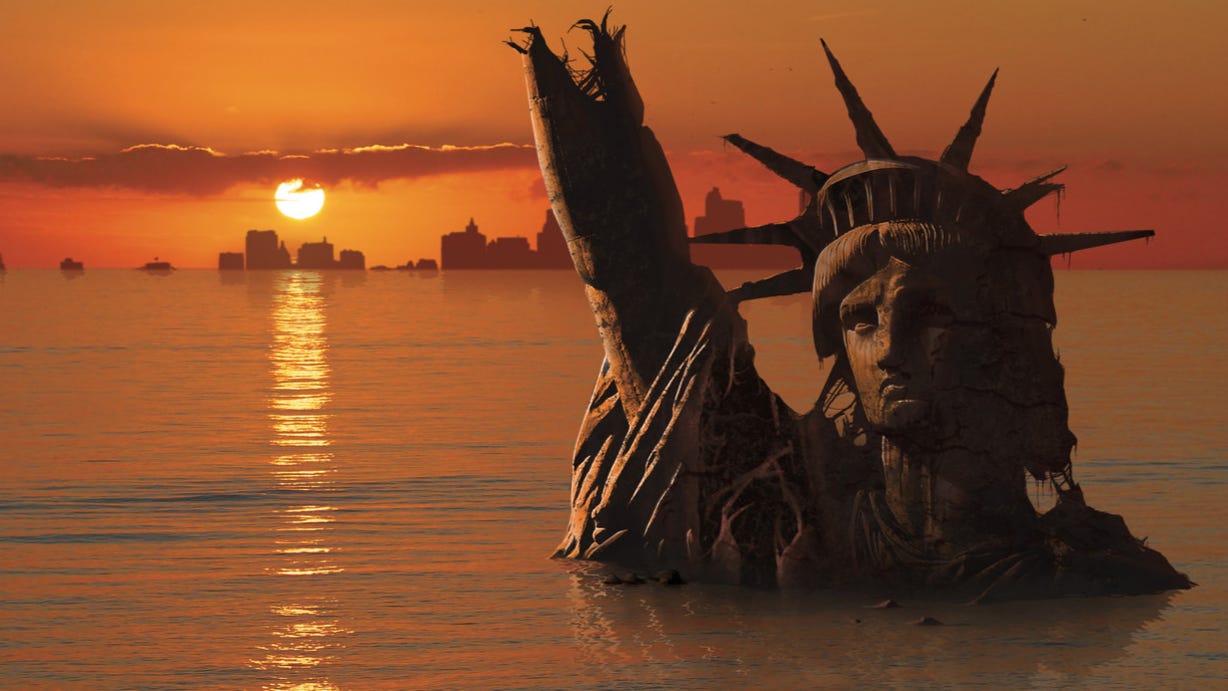
Diesen's sketch presents the unipolar vs multipolar processes as an overall inevitability, 'in the nature of things'. But many important aspects of fairly recent history and our present circumstance are not delved into. If some of these are included then the 'neat and tidy' processes sketched seem less inevitable and more influenced by historical quirks.
So for example, the long standing ambition of powerful banking interests to secretly dominate international and national political processes - as for example described in Quigley's Tragedy and Hope - was not an home brewed American 'unipolar' ambition, but a transnationally-based 'will to supreme power'.
The implied repudiation of the US Constitution by the establishment of the Federal Reserve in 1913, was based on the preparatory ability of powerful financial interests to dominate US political and mass media processes.
Thw public execution of JFK and de facto coup over the nominal Republic in 1963, and the censorship that still obscures that issue, signalled that an institutional matrix of power had subverted, replaced, and now controlled the nominal US republic.
Many other aspects like these could be mentioned.
But my basic point here is that the project that culminated in 'the American global hegemon/empire was never really an intrinsically American one, but the United States and its brainwashed people and power and wealth and capabilities were the visible part of and tool of a transnational global ambition that did not reflect the foundational principles or the interests or ambitions of the people of the United States.
A critical aspect of the generational processes that we the people have been subjected to has been the control over and subversion of information, mass media, and education itself: because the ambition of transnational hegemonic power was based on manipulating and deploying the public, keeping the public confused, misled, in the dark, brainwashed, disempowered, etc, To sustain illegitimate power, the lie and censorship and propaganda had to dominate the true, the forthright, the accurate, the logical, the sensible. etc. Which is the stuff of crazy world.
The current push back from China, Russia, Iran, North Korea, and Yemen is against not so much the power of the United States, but against the system of transnational political, financial and mass media control that had achieved effective control of the US.
Calling this push back 'multipolarity' is commonplace but somewhat misleading and questionable.
The processes which we are all now witnesses to and participants in can be seen as having a third potential 'great power' party, in addition to the typically posited 'great political national powers' and coalitions thereof: namely, the underlying public interest and the potential capabilities of a global public.
This 'third party' to the contest was through history a 'mere hewer of wood' and ploughman and subject to lordly power, etc. History's 'quirk' now sees these billions of commoners armed with and empowered by an array of information and capabilities - a vast new arsenal of technical means - to assert its interests.
The vital life affirming principle is that honesty is the best policy, that 2+2=4 is at basic odds with the BS that power previously was always dependent on.
Will the actual public interest now be more able to insert itself into the power struggle machinations of history?
Excellent analysis if the hegemon was the US 'State'. But it might have been but no longer is. The hegemon is a very particular subset of not only the US but also other states as well. This group of the combination of MIC, Big oil and gas, Big tech , and Big finance find themselves with the same basic strategy for growing their power and wealth. Whilst predominantly in the West , anglo and EU ( including Japan, SK, and Israel) they do include members of the same club in other nations, maybe including those that are apparently at odds with the hegemon.
Everything about Trump's seemingly bizzare behaviour is in service to this hegemonic club( the 'Epstein' club?). It is no concidence that the wealth created by the growing concentration of gas requirements around Texas, the LNG exports and the data center requirements are advantaged by the Qatar gas being removed from the global market. Its no coincidence that the EU/UK dependency on US LPG can now extract premium spot prices as Japan/SK compete for the same product. Its no concidence this accelerates the deindustrialisation of Europe and relocation to the same Texan areas. It is no concidence the the diesel and jet fuel crack spread is at record levels as the same vassal states compete for scarce resource from the Louisiana refineries making $billions. There is not a oil shortage per se, much more a 'refining' shortage.
It is no coincidence that the strains of scarce, expensive energy will increase the societal pressures and lead to the dissallusion of younger people with no future who will be even more ready to sign up for the new wars against Russia , Iran and China.
Overall its no coincidence that the same small group of people will indeed grow their power and wealth from this strategy. But the ordinary USians will not share in this bounty , they will suffer the same prices and scarcity of their fellow ordinary people in the vassals. The Epstein club is aiming to control the world 'for ever' initially using control of energy as the means, and for as long as it last the US armed forces as the tactical weapon.